
04-24-09 by dugan
Here’s the best proof I’ve seen that every last thing Exxon does is about the bottom line. On the 20th anniversary of the disastrous Exxon Valdez oil spill, Exxon is still running single-hulled tankers, including a sister ship of the Exxon Valdez, into the Alaskan port of Valdez. The tanker, SeaRiver Long Beach, makes regular calls into Los Angeles and San Francisco, says a thorough investigative report by Bloomberg.
What does Exxon gain from hiring the Exxon Valdez sister ship, Sea Spirit Long Beach, and others like it? About $18 million a year, says the report by Alaric Nightingale and Tony Hopfinger of Bloomberg. About a penny per share per year.
Exxon is alone among the major Western oil companies in hiring the spill-prone single hulls regularly worldwide, for more than 6 percent of its crude oil shipments.
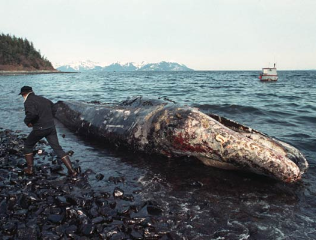
 When the Exxon Valdez ran aground March 24, 1989, a rip in the hull dumped 11 million gallons of crude oil into Alaska’s Prince William Sound. Alaska is still paying the price in lost fisheries and nearly permanent ecological damage.
Yet a similar accident on a double-hull tanker off Galveston two weeks ago didn’t spill a drop and barely registered in the news:
From Bloomberg:
On March 6, a tanker BP hired — the double-hull SKS Satilla — struck an oil rig 65 miles from Galveston, Texas, that was lost during Hurricane Ike. The incident, which caused “multiple punctures” along a 60-meter (197-foot) by 12-meter section, didn’t leak any oil, Coast Guard spokesman Tim Tilghman said from Galveston.
SKS Satilla had on board about 1 million barrels, or 42 million gallons, of crude oil.
“Because of the double hull, there’s no further penetration, other than the outer skin,” Sverre Jacob Mehn, a spokesman for the ship’s manager, Kristian Gerhard Jebsen Skipsrederi AS, said in an interview from Bergen, Norway.
Chevron, Conoco Phillips and BP never hire single-hull tankers, which are already banned in Europe. Shell still uses them but rarely, for a tiny fraction of its total shipping.
Asian shippers remain the biggest users of the much-cheaper single hull tankers, frankly admitting that it’s because they’re cheap. Exxon, in contrast, issued a stream of doublespeak to the Bloomberg reporters:
Hull design is only one of “hundreds of variables” Exxon uses in monitoring safety, and cost isn’t one of them, said Rob Young, a company spokesman. He declined to comment on the savings question because it would be an “incorrect characterization” to say its motivation in hiring the vessels was financial. He also declined to comment on whether double- hulls are intrinsically safer than singles.
That kind of language turns "corporate responsibility" into an oxymoron.
At least the single-hull tankers will be all but banned worldwide by 2015. Exxon has five more anniversaries with its risky gamble. I hope the odds hold.