
As President Obama Orders Tough
Tailpipe Regulations, Consumer Group Offers ‘A’ to ‘F’ Solutions for
Cleaner and Cheaper Transportation
Washington, DC — As President Obama announces new national tailpipe
emission standards modeled on California’s, Consumer Watchdog is
releasing a report that outlines how to affordably make the transition.
The nonprofit, nonpartisan advocacy group today sent to the White House
and Congress its new “Road to Cleaner and Cheaper” handbook, which
urges specific policies and grades vehicle and fuel choices on their
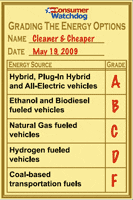
cleaner/cheaper balance, from “A” for hybrid electric vehicles to “F”
for fuel made from coal.
The vehicle/fuel grades in the handbook are:
A. Hybrid and plug-in hybrid vehicles, particularly if also capable of using biofuels. Electric vehicles.
B. Ethanol, particularly second-generation cellulosic ethanols.
B. Biodiesel, particularly if produced from a source other than soybeans.
C. Compressed natural gas. (Though CNG grade improves if used only for limited-range trucking and public transit).
D. Hydrogen. Conventional production methods energy-wasting, cost and fueling issues unresolved.
F. Fuel from coal. A polluting pork magnet for coal industry.
The handbook lists pros and cons for all of these choices, including cost and speed of development.
Sweeping curbs on global warming, including the Congressional
energy bill as well as auto emission curbs, must also get oil and fuel
markets under control and ease the transition to greener private
transportation, said Consumer Watchdog.
“The United States is far more dependent than other developed
nations on cars and roads, something that cannot be swiftly undone,”
says the handbook, written by Consumer Watchdog research director Judy
Dugan. “But it can become cleaner in affordable ways. That is the point
of this plain-language handbook.”
The “Road” handbook also urges tougher oversight and greater
transparency in energy trading markets and the fuel refining industry,
to quell speculation and gaming of markets that result in a price
roller-coaster. It suggests ways to encourage clean, renewable fuels
and protect them from start-and-stop investment.
(Download the handbook [250 KB] here, or view it online at the bottom of this page.)
“If government visibly gets oil markets and oil companies under
regulatory control, if transition costs are fairly and transparently
shared, and if the environmental benefits are clear, consumers will
embrace the goal of a cleaner transportation system that ultimately
will be cheaper than staying on the petroleum roller-coaster,” says the
introduction to the handbook.
“Our grading system will be controversial but is well-defended,” said
Dugan. “We defy anyone to show that the current practice of using
taxpayer subsidies to produce motor fuels from coal is decent public
policy, or even that automakers can produce an affordable, durable car
that runs on cleanly produced hydrogen.”
The handbook lists pros and cons for all of these choices, including cost and speed of development.
The handbook urges that clean-vehicle purchase incentives, market
regulations and tax credits from cap and trade proceeds be utilized to
keep consumers on board for steady reductions in fossil fuel use.
“Congress and the White House are aiming to complete cap and trade
legislation by the end of the year,” said Dugan. “These big initiatives
have to consider effects on consumers or risk being seen as giveaways
to industry while families pay the price. Congress can start by
mustering the will to eliminate oil drilling subsidies and redirect the
funds to green transportation.”
Showing a visible will to stand up to industry lobbying will give
Americans who have no lobby of their own more trust in all that
follows, said Consumer Watchdog.
For more information, see:
– 30 –