
Energy Firms Help Pay For State Regulators’ Far-Flung Trips
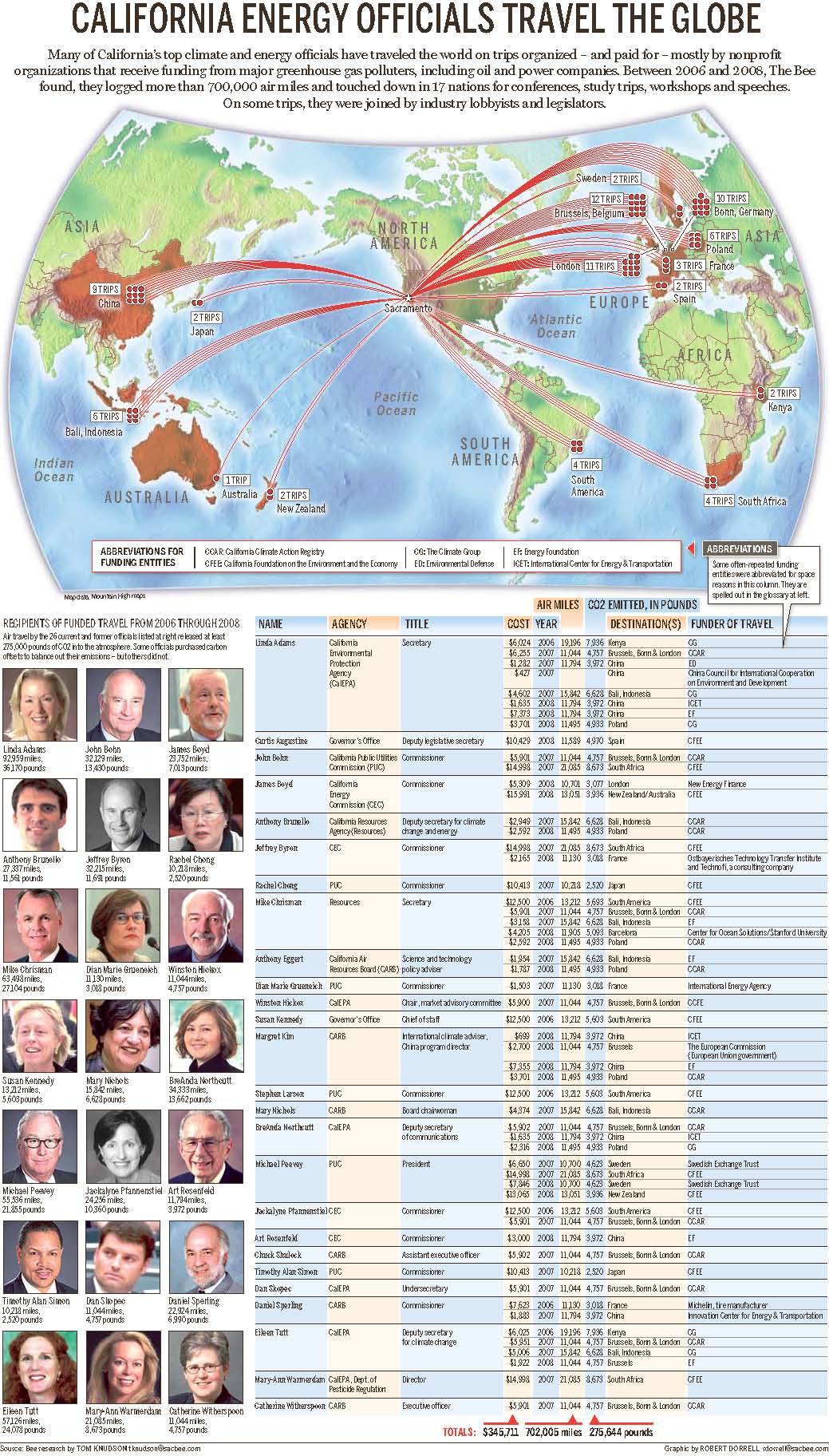
State officials who lead California’s war on global warming often
travel abroad on trips supported by the major greenhouse gas polluters
they regulate, a Bee investigation has found. Industry lobbyists and
executives routinely join them.
Since 2006, more than two dozen top state officials have fanned out
across the globe on such trips, bound for a climate change policy tour
in Europe, meetings with high-level government officials across South
America and China, even a safari in Kruger National Park in South
Africa – all on someone else’s dime.
They have logged more than 700,000 air miles and touched down in 17
nations, on trips collectively costing hundreds of thousands of
dollars. In the process, their air travel alone emitted 275,000 pounds
of heat-trapping carbon dioxide into the atmosphere.
Joining them were more than 30 business executives, at least 19 legislators and a handful of spouses and partners.
Information about these trips is not spelled out clearly on any government Web site and there is no coordinated oversight.
The Bee pieced together details from a mountain of state government
paperwork that accumulates out of public view, some of it obtained via
the California Public Records Act, including memos, itineraries,
receipts, office calendars and financial disclosure forms.
Those travel documents indicate that a who’s who of climate change
oversight in state government — from Linda Adams, secretary of the
California Environmental Protection Agency, to Susan Kennedy, chief of
staff for Gov. Arnold Schwarzenegger — mingled abroad with top
executives from Chevron, Southern California Edison, Pacific Gas and
Electric, Shell Oil, British Petroleum and others.
Industry support for those excursions did not come directly to state
officials, the documents show, which would violate a law limiting gifts
to $420 a year. Instead, it is routed through nonprofit groups, which
can spend whatever they want on state travel without disclosing
precisely who is paying for it.
Some who have participated in the trips told The Bee they now feel
uneasy about them because they played out behind closed doors with top
business leaders who stand to benefit from government decisions.
"I am uncomfortable with the repeated closeness between regulators and
utility executives that happens on these types of trips," said Dian
Grueneich, a member of California’s Public Utilities Commission, which
regulates CO2 emissions from power plants.
Grueneich attended an 11-day renewable energy study travel project in Europe in 2005 at a cost of $11,500.
Joining her were 11 other state officials — eight of them legislators
— one environmentalist and executives from five energy and utility
giants: Chevron; PG Southern California Edison; a branch of
international mining giant BHP Billiton; and Calpine, a Houston-based
power company that delivers electricity to more than a dozen states,
from New York to California.
"You have repeated interactions with the top management of the
companies we are charged with regulating," Grueneich said, "in private,
nonpublic settings."
Critical juncture The travel has occurred at a critical juncture — as
California conceived, approved and now prepares to enforce its
pioneering Global Warming Solutions Act of 2006. That law drew national
acclaim with its calls for slashing greenhouse gas emissions to 1990
levels by 2020.
Reaching that goal, according to the California Air Resources Board,
will require a tsunami of new regulations, incentives and programs,
including lower carbon transportation fuel, more solar panels on
rooftops, a high-speed rail system and a carbon trading system embraced
by industry.
Putting all that into place is not only a challenge. It is also a
ticket to travel — an opportunity for California leaders to tout the
state’s new law and seek out clean energy lessons learned elsewhere.
And the more private funding for it, the better for cash-strapped
California, said Lisa Page, spokeswoman for Schwarzenegger.
"These trips are educational and do not cost the public a dime," she said.
Yet most travel occurs on state time. A two-week trip for an agency
secretary costs taxpayers about $7,000 in salary, records show.
Expenses not covered by nonprofits, such as transportation to and from
the airport in California, airport parking, visa fees and some meals,
add to the taxpayer tab.
Invitations and itineraries Sometimes, invitations come in letter form.
"Dear Mr. Larson, I am writing to invite you to participate in an
International Study Travel Project to South America…." one letter to
former California Public Utilities Commission Executive Director
Stephen Larson begins, emphasizing the destination in bold font. Sent
by the California Foundation on the Environment and the Economy, it
continues:
"As a 501(C)3 non-profit, CFEE is able to host your airfare, hotel and
ground transportation in full compliance with California Fair Political
Practices Commission rules."
Other offers are more discreet.
"When I first joined the Public Utilities Commission, it was made known
to my staff that I could pick where I wanted to travel, in the world,"
said Loretta Lynch, president of the PUC from 2000 to 2002.
Often, the nonprofit-funded travel is tied directly to official global
warming-related gatherings, such as the U.N. Climate Change Conference
in Bali, Indonesia, in 2007, attended by six state officials.
Much of it is aimed at pursuing one of Schwarzenegger’s grandest
dreams: battling global warming with strategies friendly to business,
including a cap-and-trade system that allows companies to meet CO2
targets not by reducing emissions directly but through purchasing
carbon credits and offsets from someone else.
Still other excursions are sumptuous, customized outings that unfold at
a more leisurely pace and include business- and first-class flights,
stays in luxury hotels and elaborate, industry-sponsored meals and
dinners.
In 2006, one memo advised state travelers bound for Brazil and
Argentina on a climate change and alternative fuels tour to bring
swimsuits "as it is heading into summer in South America and you will
have a day off in some cities."
The $12,500-per-person outing, which included a stop at the five-star,
beachfront Copacabana Palace hotel in Rio de Janeiro, was booked by a
San Francisco travel agency called Rascals in Paradise. It was paid for
by CFEE, which is funded by major oil and utility companies.
CFEE will not disclose how much revenue it receives from each of its
more than 30 business and corporate members, from Goldman Sachs to
PG&E or the four environmental groups it also counts as members.
(Last week, PG&E said it donates $45,000 a year to CFEE from its
charitable contributions program. The money comes from shareholder —
not ratepayer — funds and is approved by the board, a spokesperson
said.)
"No one organization gives more than 4 percent of our operating
budget," said P.J. Johnston, spokesman for CFEE. But he added, "I’m not
going to break down the internal workings of this organization beyond
what’s required by law."
No alternative, some say With so much energy and climate regulation in the works, more transparency would be a plus.
"This funneling of money through nonprofits really is a perversion of
the system," said Lynch, who said she ultimately chose not to
participate in a CFEE-funded overseas trip. "I think it’s terrible
government. It undermines transparency and accountability."
"I suggested to various legislators that they should ban this practice," she added. "The problem is the Legislature went, too."
Some travelers were not eager to discuss the trips. Those who did
generally fell into two distinct camps – they were concerned about the
industry funding and access or they were comfortable with it and had a
good time.
"If you have a good record of being a public servant, this is not going
to soften you up," said James Boyd, a member of the California Energy
Commission who flew to New Zealand and Australia on a CFEE trip last
year at a cost of $15,998. "It opens doors to dialogue – not to give
away the farm."
Some maintained that there is no alternative.
"To be honest, the state can’t cover the costs," said Eileen Tutt,
deputy secretary for climate change at the California Environmental
Protection Agency. "And yet it’s important that policymakers take these
trips."
Tutt was one of at least nine state officials who joined in a 2007
"European Climate Policy Study Trip" organized by the California
Climate Action Registry, a nonprofit formed by the Legislature and
business leaders to track CO2 emissions and reductions.
Despite its public roots, the registry, which also is funded in part by
oil and utility companies, often prefers to operate in the shadows.
Just before the 2007 trip, for example, Robyn Camp — registry vice
president of programs — sent an e-mail to California energy
commissioner Jackalyne Pfannenstiel that read: "We will be talking with
high level people everywhere… Many of our discussions will be
private, to facilitate discussions."
The registry also would not disclose travel expense records of the
state officials who attended — at a combined cost of about $60,000.
Registry documents obtained independently by The Bee show state
officials were joined by at least half a dozen oil and power company
executives and lobbyists and the trip was funded by Shell Oil,
Occidental Petroleum, Sempra Energy, BP and other companies.
According to travel documents, optional activities included a guided
tour of the German city Cologne, a jazz concert, a ride on the London
Eye — the largest Ferris wheel in Europe — and tickets to a play in
London’s theater district.
Diane Wittenberg, former registry president, said industry support for the trip was necessary — and appropriate.
"I can’t imagine a lot of people would say, ‘Well, the taxpayers should
fund that,’ " said Wittenberg. "Energy companies are the first line of
greenhouse gas emitters. They are big emitters. They were very
interested in learning about what was happening in Europe."
"State officials wanted the opportunity to have these meetings," she
added. "I can’t speak for them, but I would imagine they didn’t feel
they would be unduly influenced by anybody on the trip they saw on a
bus or at a meal."
A $1,000 a day loophole By law, state officials cannot accept gifts
from companies worth more than $420 in a year. But when donations are
routed through nonprofit organizations, as travel "reasonably related
… to an issue of state, national or international public policy," the
sky is the limit.
Many overseas policy tours cost an average of $1,000 a day, per
person, including airfare. Individual tabs often exceed $10,000. Costs
have climbed, too — from a high of $12,500 per person in 2006 to a
high of $16,000 last year.
"This is one of the chief loopholes companies use to exert too much
influence on California policymakers," said Doug Heller, executive
director of Consumer Watchdog, a Santa Monica group that monitors state
government and has investigated some of the trips.
"These are luxury vacations paid for by special interests," Heller
said, adding, "These trips are very much about managing greenhouse gas
emissions in a way that is most profitable for companies – and less
effectively than is needed."
The funding for such trips often is well disguised. Consider the
European Climate Policy Study Trip attended by top state policymakers,
including Linda Adams, chairwoman of California’s Climate Action Team
and the state’s lead climate change negotiator.
On financial disclosure forms, Adams and other officials reported the
cost of the weeklong trip, ranging from $5,900 to $6,255 per person.
And they noted the source of the funds: the California Climate Action
Registry.
But the funds actually came from somewhere else: the biggest oil and power companies in California.
"The money that funded this trip came from the corporate sponsors who
went on it," said Jennifer Weiss, a spokeswoman for the registry.
Most of the trip sponsors were energy companies. But Weiss said it
wasn’t meant to be that way. Others were invited, "but the people who
were able to make time on their schedules happened to be energy sector
people."
Those slated to go included very senior energy people, documents show:
John Fielder, president of Southern California Edison; Nancy McFadden,
vice president of government affairs at PG and Jack Coffey, director of
California government affairs for Chevron.
Conflict alleged The aim of the study trip was to learn more about
Europe’s experiment with carbon trading, one of several approaches
California is pursuing to shrink its carbon footprint and the cheapest
option for energy companies.
A glance at their itineraries shows that state travelers found their
days occupied with sessions and presentations on carbon trading,
including a working lunch with carbon industry representatives titled
"business opportunities supporting carbon markets."
Catherine Witherspoon, former executive officer of the Air Resources
Board, participated in the trip, attended many sessions and was not
troubled by the industry funding or participation.
"Since they did it via grants … and weren’t in control of the agenda
or what was said, I think it was fine," Witherspoon wrote via e-mail
while on vacation. "In this case, industry wasn’t trying to co-opt us
to their preferred approach by wining and dining us overseas. They were
confronting a potential vision of their future in the U.S."
Adams posted blogs from the European trip on Schwarzenegger’s Web page,
that touched on the value of environmental regulations and the promise
of a carbon market. "Despite a recognition that the European … system
had a bumpy start, overall support for a market system was unanimous,"
she wrote.
In the blog, Adams did not mention that her trip was paid for by companies that stand to benefit from carbon trading.
Asked about the registry trip last week, Adams said she saw no conflict of interest.
"Everyone on the trip had the same goal: to learn how to reduce global
emissions in the most cost-effective manner," she said. "But not
everyone had the same view."
Others are skeptical.
"If President Obama was taking a trip to Israel to discuss foreign
policy issues, and his plane ticket and accommodations were paid by the
Jewish Federation, I think the public would be screaming," said Jane
Williams, executive director of California Communities Against Toxics
north of Los Angeles. "That’s the issue."
Williams is one of several "environmental justice" advocates in the
state who favor a tougher approach to climate change that would force
energy companies to reduce CO2 emissions on site – not through trading.
She co-chairs the Air Resources Board’s environmental justice advisory
committee.
"What carbon trading is about is keeping the wheels on the fossil fuel
industry," Williams said. "It’s not about actual emission reductions.
You are stranding the continued reliance on fossil fuel in communities
that are highly vulnerable – in low-income communities and communities
of color."
Focus is on business Working toward a low-carbon future is a familiar
topic on the CFEE trips that take officials around the world. And
Johnston, the group’s spokesman, said environmentalists are invited
along for balance.
"We have arguably one of the few places where the Environmental Defense
Fund can sit and have a reasonable discussion with energy companies and
study the problems that face us," he said.
But documents obtained by The Bee from the foundation and other sources
show just one or two environmentalists are invited on the overseas
trips — and all come from groups that support carbon trading. One
person counted as an
environmentalist by the foundation is Wittenberg herself, the former
registry president and also a former vice president of corporate
communications at Edison International.
"They invite a couple of compliant nonprofits along to make it look
good," said Mindy Spatt, a spokeswoman for The Utility Reform Network,
which is skeptical of carbon markets. "They don’t take people like us
to New Zealand, you can be sure."
Trip itineraries show a distinct business focus, from a meeting with
the American Chamber of Commerce in Cape Town, South Africa, to a
luncheon sponsored by Chevron Brazil in Rio de Janeiro.
Among those attending the South America trip in 2006 were Susan
Kennedy, the governor’s chief of staff who had just played a key role
in shaping the state’s climate change law, and her partner, Vicki Marti.
Last week, Lisa Page, the governor’s spokesperson, said Kennedy would
not make herself available for an interview – but Page said that
important advances related to low carbon fuel emerged from
conversations with an environmental leader on the trip. She also said
Marti paid her own way.
The itinerary for the trip reads as if it might belong in the
television series "Lifestyles of the Rich and Famous": Copacabana
Palace (one night)… The Ritz Carlton (2 nights)… Reception in
vineyard gardens — guest to include U.S. Ambassador to Chile… .
"I understand there are those who think it’s someone paying for a
junket – that’s not what we do," said CFEE’s Johnston. "These are
working trips. … It would be foolish for the people who make
important decisions for California to stick their heads in the sand and
not look at what the rest of the world is doing."
Boyd, the energy commissioner, agreed, saying he picked up ideas about
alternative energy and carbon capture and sequestration on his trip to
New Zealand and Australia.
"These are interesting times, energy-wise," he said. "Interacting with
other governments and finding out what they’re doing has a lot of
value."
Not all trips play out so well. In Europe on a CFEE trip a decade ago,
former PUC Commissioner Carl Wood found himself simply bored.
"Frankly, the program was not very interesting," he said. "It was kind of a zero, as far as substance."
There was one thing Wood found intriguing, however: the nonstop chatter between industry officials and state leaders.
"When you are sitting on a bus driving through Spain, there is not much to do but talk," Wood said.
"Access to anybody who is in a position of power is something that is
very valuable," he added. "And this is something the CFEE trips afford
to the participants. That’s the reason the money comes in."
CALIFORNIA FOUNDATION ON THE ENVIRONMENT AND THE ECONOMY
The California Foundation on the Environment and the Economy, based in
San Francisco, has been organizing "study policy trips" to the far
corners of the Earth since 1979. It is the major source of nonprofit
travel for state energy and climate officials.
CFEE’s funders include many major oil and utility companies, along with
some labor unions and four environmental groups. A complete list of
these funders, listed as "members," can be viewed at
www.cfee.net/board-of-directors.html
Public records show CFEE has funded trips totaling about $170,000 for
state officials since 2006, for travel to Spain, Japan, New Zealand,
Australia, South Africa, Brazil, Argentina and Chile. When legislators
are included, that amount grows.
CFEE’s IRS tax form for 2007 reports overall revenues of $1.3 million.
Communications director P.J. Johnston said that no member contributes
more than 4 percent — or $52,000 — but declined to provide an
additional breakdown. Pacific Gas & Electric said it gives $45,000
a year, from shareholder funds.
Johnston said the group has a sliding scale of member dues. "We try and
make it so the organizations with shallower pockets, such as nonprofits
and especially the environmental organizations, are able to
participate," he said.
Consumer advocates are highly critical of the CFEE-funded trips,
particularly because they give industry lobbyists direct access to
policymakers and legislators.
"This just gives Goliath another weapon, basically," said Mindy Spatt,
communications director for The Utility Reform Network, an energy
watchdog in San Francisco. "Ideally, we would have equal access to
people in power. And we don’t."
Call The Bee’s Tom Knudson at (530) 582-5336.