
03-08-09 by dugan
"Move over, Big Oil. There’s a new VIP guest in the White House: Silicon Valley." Writers know you have to nab readers with the lead paragraph. That one above, by Erika Lovley of Politico for a story on the politics of the "smart grid" is a champ.
Who wouldn’t want IBM and Google talking energy policy with President Obama, rather than Exxon and Shell dictating policy in secret meetings with Dick Cheney?
But even if Darth has retired to his secret location that doesn’t mean, to paraphrase Ronald Reagan, that "mistakes can’t be made." The White House intention to upgrade and green the nation’s electricity supply grid into a "smart grid" has plenty of opportunities to stumble.
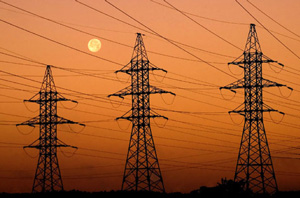
The biggest is not in the Google end of the grid, involving digital information and control of power use. It’s in utilities that will build hundreds, maybe thousands, of miles of new ultra-high-voltage transmission lines–ostensibly only to carry wind, solar and other renewable power from sunny, windy, unpopulated places to cities.
President Obama’s stimulus bill marks $10 billion just for transmission and distribution. And Sen. Harry Reid of Nevada has announced a bill to let the federal government override state objections to the transmission lines.
So what could go wrong with that?
 Size and placement: Transmission lines are by definition big and ugly. As a recent battle won by Sempra Energy in San Diego shows, parklands, even wilderness, won’t be protected. A lot of virgin land will be sacrificed.
Coal has more than equal rights. Current law gives no preference to renewables on transmission lines. Utilities, no matter how green they talk, want their lines to carry 24-hour sources of electricity: i.e. coal and natural gas, not daytime solar or intermittent wind. There’s no guarantee that the new transmission system will carry even mostly renewable power. One proposal in the Senate would give line "preference" to renewables, but new coal power, even lots of it, won’t be excluded.
"Small solar" will lose out. Rooftop solar panels placed right in urban areas that need the power won’t be a priority for big utilities that get their big transmission projects.
But "small solar" is bigger than we think. Opponents of "Big Transmission" argue persuasively that smaller rooftop solar and baby-sized wind farms in and near urban areas can displace a lot of costly, destructive high-voltage transmission.
Here’s a story from the Nation magazine article cited in the link above:
To be sure, the romance of a renewable national grid is classic American
thinking: a big problem requires a big solution. But the distributed
generation approach (DG in energy lingo) is emerging from advances in
solar technology and detailed studies of alternatives to big power-line
projects. Consider what happened when Minnesota regulators looked
carefully last year at the CapX 2020 project, a proposed cluster of new
power lines costing up to $1.7 billion. A key purpose of the lines was
to link Minnesota with proposed wind farms in the Dakotas. This is just
the type of project favored by [T. Boone] Pickens and other supporters of big
electric transmission. But after examination the regulators found that
Minnesota could develop many small 10-40 megawatt wind farms within the
state totaling 600 megawatts–equivalent to a modern power
plant–without any new transmission.
"We call it the ‘600 megawatts for nothing’ study," said Mike Michaud, an engineer and consultant who formerly worked with the state regulatory staff. "There was no denying there were twenty spots on the existing grid [where] you could put generation for no cost at all."
So transmission on a smart grid has to be more complicated than a big, romantic-sounding (costly, ugly) web of high-voltage lines across the desert and plain.
There’s another, less costly half to the smart grid-the digitizing of information about our power usage, right down to giving customers feedback in real time about how much power our homes are sucking. This information would allow utilities to price power higher when usage goes up-not just by night and day, but by hot and cold, and minute by minute.
Utilities would also reap a lot of information about our power usage, right down to what appliances we’re using. Who controls that information, and how it’s used, are another story OilWatchdog will take up later.